Tuesday, 10 November 2020

INS Kursura (S20), Visakhapatnam


INS Kursura (S20) was a Kalvari-class (variant of the Foxtrot-class) diesel-electric submarine of the Indian Navy. She was India's fifth submarine. Kursura was commissioned on 18 December 1969 and was decommissioned on 27 February 2001 after 31 years of service. She participated in the Indo-Pakistani War of 1971, where she played a key role in patrol missions. She later participated in naval exercises with other nations and made many goodwill visits to other countries.


INS Kursura underway 

History
India 
Name:INS Kursura
Builder:Sudomekh, Admiralty Shipyard 
Launched:25 February 1969
Commissioned:18 December 1969
Decommissioned:27 February 2001
Identification:S20
Fate:Museum Ship at RK Beach, Visakhapatnam 
General characteristics
Class and type:Kalvari-class Submarine 
Displacement:
  • 1,950 t (1,919 long tons) surfaced
  • 2,475 t (2,436 long tons) submerged
Length:91.3 m (300 ft)
Beam:7.5 m (25 ft)
Draught:6 m (20 ft)
Speed:
  • 16 knots (30 km/h; 18 mph) surfaced
  • 15 knots (28 km/h; 17 mph) submerged
Range:
  • 20,000 mi (32,000 km) at 8 kn (15 km/h; 9.2 mph) surfaced
  • 380 mi (610 km) at 10 kn (19 km/h; 12 mph) submerged
Test depth:985 ft (300 m)
Complement:75 (incl 8 officers)
Armament:
  • 10 × 533 mm (21 in) torpedo tubes with 22 Type 53 torpedoes
  • 44 mines in lieu of torpedoes

After decommissioning, she was preserved as a museum for public access on RK Beach in Visakhapatnam. Kursura has the distinction of being one of the very few submarine museums to retain originality and has been called a "must-visit destination" of Visakhapatnam. Despite being a decommissioned submarine, she still receives the navy's "Dressing Ship" honour, which is usually awarded only to active ships.


Description 

Kursura has a length of 91.3 m (300 ft) overall, a beam of 7.5 m (25 ft) and a draught of 6 m (20 ft). She displaces 1,950 t (1,919 long tons) surfaced, 2,475 t (2,436 long tons) submerged and has a maximum diving depth of 985 ft (300 m). The complement is about 75, including 8 officers and 67 sailors.

Telegraph dials aboard the submarine


The submarine has three shafts, each with a six-blade propeller. She is powered by three Kolomna 2D42M diesel engines, each with 2,000 horsepower (1,500 kW). She also has three electric motors, two of them with 1,350 hp (1,010 kW) and one with 2,700 hp (2,000 kW). She can achieve a maximum speed of 16 knots (30 km/h) when on surface, 15 knots (28 km/h) when submerged and 9 knots (17 km/h) while snorkelling. She has a range of 20,000 mi (32,000 km) at 8 kn (15 km/h; 9.2 mph) when surfaced and 380 mi (610 km) at 10 kn (19 km/h; 12 mph) when submerged. There are 10 torpedo tubes to carry 22 Type 53 torpedoes. She could lay 44 mines instead of torpedoes. She also had a snoop tray and I-Band radar for surface search.

The six torpedo tubes of Kursura. Note two of them are loaded with torpedoes

Operational History 

 Kursura was commissioned on 18 December 1969 at Riga, Soviet Union. She was India's fourth submarine. Kursura's first commander was Commander A Auditto. She began her maiden voyage to India on 20 February 1970. During her homecoming voyage, which lasted from February to April 1970, she visited Göteborg, La Coruña, Takoradi and Mauritius. Kursura, along with sister boat INS Karanj, were made operational under the Indian Navy's Western Naval Command, and reported to the Flag officer Commanding-in-Chief Western Naval Command (FOCINCWEST). They were ordered to patrol approaches to Pakistan's Karachi harbour and Makran Coast, for which they established waiting stations and submarine havens. 


In 1970, Karanj was badly damaged after a collision with the destroyer Ranjit when she surfaced directly below the ship. As no drawings of the damaged portions of the boat were available with the Bombay Dockyard or the Indian Navy, it was decided to use Kursura, which was already docked at Bombay, as the design template for the metal work, and Karanj was repaired within months, in time to join the Indo-Pakistani War of 1971.


Indo-Pakistan War of 1971

During the Indo-Pakistani War of 1971, Kursura operated in the Arabian Sea. She was given the patrol duties at two designated areas before the war started, but was ordered to operate under two restrictions: she was not to cross demarcated shipping corridors and she could attack a target only after positive identification. The aims of her patrol were to sink any Pakistani naval warships, to sink merchant shipping when specifically ordered, and to conduct general patrol and surveillance. 

She started from her home port on 13 November 1971 and reached her patrol location by 18 November. She remained there until 25 November when she was shifted to a new patrol location and remained there until 30 November. On 30 November, she rendezvoused with Karanj at sea to transfer instructions and subsequently then left for Bombay and reached there by 4 December 1971. During her patrols, she encountered fair weather and monitored a number of tankers and commercial aircraft flying on international routes. She was originally intended to lay mines but the plan was later cancelled.


Later service

Kursura was used for test firing the NSTL 58 torpedo in 1975. She was laid off for many years to be cannibalised for spare parts for other submarines, but underwent a refit in the Soviet Union between September 1980 and April 1982, and was made operational again in 1985.

Along with INS Taragiri, she participated in the first anti-submarine warfare(ASW) training exercise with the RSS Victory of Singapore off the coast of Port Blair between 21–24 February 1994. She participated in the second ASW exercise with Singapore along with INS Dunagiri, RSS Valour and RSS Vigilance. She visited Singapore and Jakarta, Indonesia, in December 1994 on a good-will visit.

After a service of 31 years and traversing 73,500 nautical miles (136,100 km; 84,600 mi), she was decommissioned on 27 February 2001. Despite being a decommissioned submarine, she still receives the navy's "Dressing Ship" honour, which is usually only awarded to active ships.


Museum ship (2002 – present)


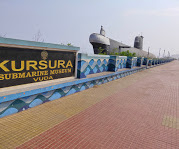
Kursura as a museum ship in Visakhapatnam


Kursura undergoing repairs in 2013

After decommissioning, the ship was towed to RK Beach in Visakhapatnam and was established as a museum ship, which is the first submarine museum in South Asia. The idea of the boat's conversion to a museum is credited to Admiral V Pasricha. Towing the submarine 600 metres to its final location took 18 months and cost ₹ 55 million. It was inaugurated on 9 August 2002, and it was open to the public from 24 August 2002. Six retired naval personnel serve as guides and another one as the curator. 

Kursura has the distinction of being one of the very few submarine museums to retain originality. She has become a famous tourist attraction of the city and has been called a "must-visit destination" of Visakhapatnam by The Hindu.  Out of the ₹ 10 million revenue generated every year by the museum, ₹ 8 million is used for the submarine's maintenance. During the first four months of the museum's operation, it was visited by about 93,000 people. Daily visitors usually range between 500 and 600 and shoot up to 1,500 during the tourist season. 

In September 2007, Vice Admiral Carol M. Pottenger of the United States Navy visited the submarine when she wrote in the guestbook "What a fantastic experience. The Indian Navy should be very proud of this awesome display". She said that the submarine was very well preserved and they did not have anything similar to it in the United States. A major overhaul was done in December 2007 to repair her hull's corrosion. New steel plates were arranged at a cost of ₹ 1.5 million. As of August 2008, about 1.5 million people had visited the museum, and in 2010, she was visited by 270,000 people. 


Saturday, 7 November 2020

Bapu Museum, Vijayawada


Bapu Museum ( Victoria Jubilee Museum) 

The Bapu Museum (formerly: Victoria Jubilee Museum) is an archaeological museum, located at M. G. Road of Vijayawada. It was renamed in the memory of the renowned film director, illustrator, cartoonist and author Bapu (film director). The museum is maintained by the Archaeological department and has large collection of sculptures, paintings and artifacts of Buddhist and Hindu relics, with some of them as old as 2nd and 3rd Centuries. The structure of building is an Indo-European style of architectural and is more than a hundred years old structure.


A high-tech 3D mapping visualisation is a much-awaited feature in Bapu museum which is likely to reopen soony. The Coastal Museum, housed in an over-100-year-old building, will be thrown open to the public with many new frills. The scene of freedom fighter Pingali Venkaiah presenting a design of the National Flag to Mahatma Gandhi when he came to Bezawada in 1921 in 3-D Visualisation will be one of the big attractions.


Statue of Nuzvid Zamindar at bapu museum


The museum structure, which earlier housed the Victoria Jubilee Museum, was built in 1887 and was renamed after the famous Telugu illustrator and filmmaker Bapu.


The lush green lawn and the old tall trees are inviting while the Indo-European architecture of the building is awe-inspiring.


The museum had to be closed a couple of years to facilitate repairs to the old structure. A new structure has come up beside the century-old one as part of the upgradation of the museum as a Coastal Museum.


Beautifully carved marble sculptures of prominent leaders portraying the 1921 flag-presenting occasion dot the old building.


The 3D technology has been brought into play to makes people feel close to reality besides helping them gain knowledge about the significance of this place in the history.


The new building has pre-historic tools, manuscripts, stone cut writings, armours and shields used by kings in addition to idols belonging to the second and third century.


Visitor Facilities : Clean, cool drinking water and good toilets are provided. Seating arrangements have been provided in the garden. A Companion Guide to the Museum is also available at Rs.20/-.


Address : MG Rd, Buckinghampeta, Vijayawada, Andhra Pradesh 520002


Timings : The Museum is open from 10.30 AM to 5.00 PM and closed on Fridays and Public Holidays.


Entry Fee : Rs.5/- for adults and Rs.3/- for children.


Friday, 6 November 2020

Archaeological Museum, Amaravati


The Amaravati Archaeological Museum is a museum located in Amaravati, a village in Guntur district of the Indian state of Andhra Pradesh. It is running by Andhra Pradesh tourism. It opens at morning 10:00 and closed at 5:00 pm and Friday holiday. It also consists modal of Amaravathi Mahachaitya.


Amaravathi Archeology Museum


The Archaeological museum at Amaravati is a home to many relics that dates back to thousands of years, found during excavations. This museum unfolds the wealth of Amaravati that belonged to 3rd century BC, through the galaxy of sculptures that once were a part of Mahachaitya (the Giant Stupa).

There are different galleries that take you close to the very old history of Amaravati and the life of the Buddhists in those days.

In the first gallery we can find the ancient art traditions of Amaravati. The Purnakumbha designs and the Lotus designs here express the intricate art of those days. The two drum of slabs depicting the Stupas, Svastika mark on the cushioned seat of the throne under the Bodhi tree which is considered as symbolical representation of Lord Buddha, the Agni Skanda (Flaming pillar), the dome and the standing Buddha belonging to 8th century are the master collections of this museum.


The Agni Skanda ( Flaming Pillar) 


The second gallery of the museum shows the life size standing image of Buddha with Maha Purusha Lakshana (Marks of a great man). A beautiful round panel over a cross bar which is engraved with the episode of Rahula s presentation to Buddha by his father Suddhodhana is a marvellous piece in narration and carving in the museum. There are also some gold coins and beads belonging to that period.


Hindu deity statue


The third gallery exhibit some of the beautiful sculptures belonging to 2nd century BC. Some of them include Yakshi of Bharhut tradition, a stele (an ancient stone, slab or pillar) with labelled panels, fragmented pillar edict of Asoka, images of Buddha from Alluru, Dharma Chakra from Lingarajapalli, Bodhisatvas and a dome slab depicting the jewels of Buddhist order viz. The Buddha, Dhamma and Sangha in a panel represented by a Bodhi Tree and the Stupas worshipped by devotees are all noteworthy. The couple in round in the central showcase is a masterpiece of Amaravati Art, with full of vigour and vitality of the Satavahana period. The life size Nandishwara (bull) of Satavahana period marks as an attractive piece of the museum.


Stupas Hall


The museum has panels that portray the model of Stupa, a part of reconstructed railing, Siddhartha s departure from his palace, episode of Nalagiri, which was the royal elephant of Ajaatasatru, worship of Buddha s feet by lady devotees, and many more that gives you a glimpse of historic days. For many years, the Amaravati sculptures in the British Museum were not on display but were stored in the museum s basement. A few years ago, the museum constructed a new gallery for these sculptures. In an attempt to convey the significance of these sculptures and how they originally looked, a section of the Stupa has been recreated by arranging the sculptures on the gallery wall up to height of 15 feet. A portion of the railing or fence has also been reconstructed in front of the gallery. As the sculptures are extremely sensitive to air pollution and changes in temperature, the gallery has been de-humidified and air-conditioned and is enclosed by a glass wall. The Madras Museum has now announced its plans to renovate its Amaravati Gallery.


Entrance of Museum


The Archaeological museum is closed on Fridays and on other days it is open from 10:00 am to 5:00pm. The entrance fee is Rs.2 per head for elders and children above 15 years of age.
The museum is opposite to the bus station. If you are coming from Vijayawada or Guntur, You will get a main road when you entered into amaravathi. There turn to your left hand side go straight you will see the museum opposite to bus station.


North Bengal Science Centre, Siliguri

North Bengal Science Centre 


Science city is located 5 km north of the Siliguri city. Situated in the Matigara alongside the National Highway 31, this is also popular as the North Bengal Science Centre. The centre exhibits a wide range of scientific projects and equipment. Different astronomical shows are also conducted in the planetarium here. The Science city has also become the most frequented place for the educational tours. Gadgets housed at the centre bring forth the basic scientific principles in a very simple and interesting manner thereby making learning science a lot more fun. Most experiments conducted here relate to the everyday life science. It also displays the biodiversity and the different flora and fauna of the Siliguri city.


Historical Context: It is one of the largest science centre in the world, and is developed by the National Council of Science Museums.


Museum with a planetarium, science shows & diverse exhibits, plus a quirky exterior dinosaur statue.


North Bengal Science Centre 

Address : 

Indian Institute Of Polymer Science, Siliguri, West Bengal 734003, India. 


Timings : 

10:30 AM - 6:00 PM


Recommended Hours : 

Min. 3 hours


Best Visited With :

 Group, Solo, Couple, Family


Not Allowed : 

Pets


Entry Fee

INR 40


Allowed

Footwear, Camera, Video


Bihar Museum

  Bihar Museum, Patna  Bihar Museum is a museum located in Patna. It was partially opened in August 2015. The children's museum', th...